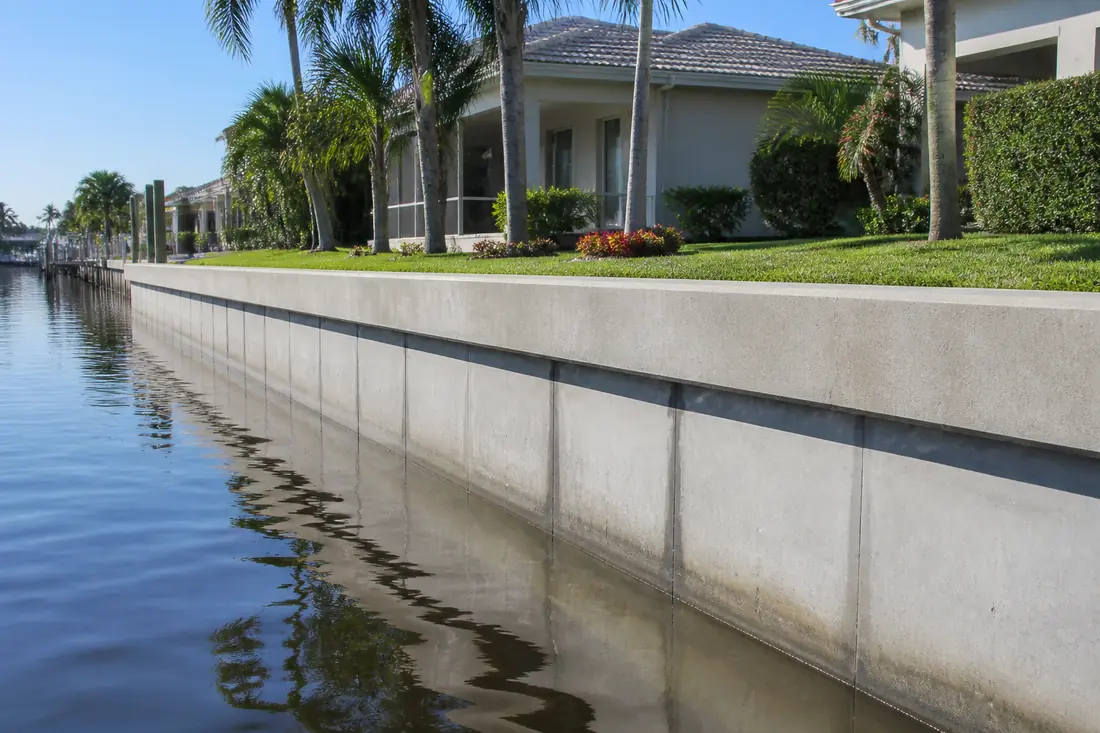
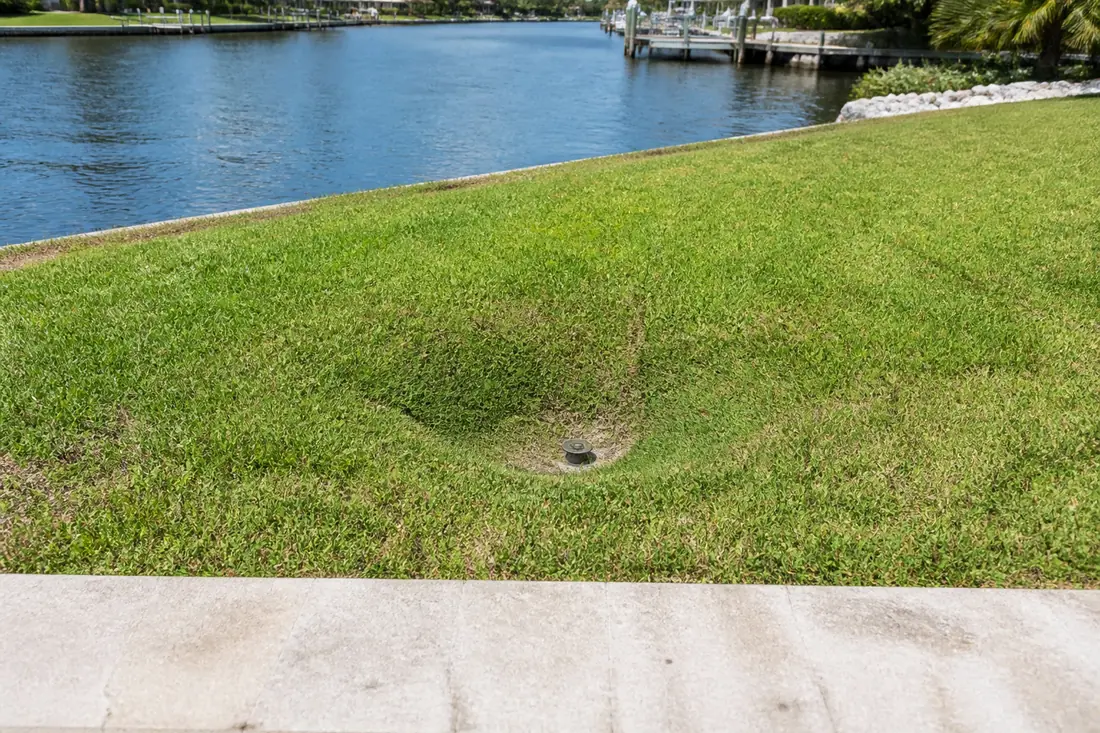
The wall has a bulge in it. Or the lawn has a soft spot a few feet back from the cap that was not there last year, and a sprinkler head now sits an inch below the grass around it. Two contractors have looked at it. One says the work needs a permit and will take months. The other says it is a repair, no permit required, and can start next week.
Both of them may be describing the same wall correctly. Florida’s exemption for seawall work is written in a way that puts nearly identical-looking jobs on opposite sides of a line, and the line is not where most owners assume. It does not run between “small job” and “big job.” It runs between what you are doing, where the wall is, how far waterward the new one sits, and — in one case that matters enormously in Charlotte County — how long ago the damage happened.
Getting this wrong is expensive in a specific way. It is not usually a fine. It is a job that stops halfway, with the old wall out and the new one not yet in, while an application that should have been filed months earlier goes through review.
The rule that decides it
Seawall work in Florida runs through the Environmental Resource Permit program. Much routine residential-canal work proceeds under an exemption rather than an individual permit, because Rule 62-330.051 of the Florida Administrative Code lists activities that are exempt from one. Subsection (12) is the shoreline stabilization part, and it is worth understanding in its own words rather than in a contractor’s summary of them.
The first piece, at 62-330.051(12)(a), covers the “construction, replacement, and repair of seawalls or riprap in artificially created waterways” and within residential canal systems, along with backfilling to level the land behind the structure.
Read that twice, because it is doing more work than it appears to. This first exemption is tied to the kind of water body you are on. A canal cut out of dry land for a residential subdivision is an artificially created waterway. The open shoreline of Charlotte Harbor is not. Two properties four miles apart, both with a failing concrete wall, can sit under different rules — and the one on the harbor is the one that surprises people, because it looks like the simpler site.
That is not the end of it for open shoreline, and this is where a lot of bad advice lives. A separate subsection, 62-330.051(12)(c), exempts “the construction of seawalls or riprap in wetlands or other surface waters between and adjoining existing seawalls or riprap at both ends,” in accordance with section 403.813(1)(o) of the Florida Statutes. Riprap under that exemption is subject to the same length and orientation limitations as a seawall.
So the question on an open shoreline is not simply whether the water is natural. It is also what your neighbors have. A gap between two existing walls that your wall would adjoin at both ends is a different case from an unarmored stretch of shoreline, and the two are treated differently. Anyone who tells you flatly that open water means a full permit has answered only half the question.
The clock most owners never hear about
The second piece is the one that catches owners who deferred storm-related work past the window.
62-330.051(12)(b) covers restoring a seawall or riprap that has been “damaged or destroyed within the last year by a discrete event, such as a storm, flood, accident, or fire.”
That is not the only route through (12)(b). The same subsection also reaches restoration or repair involving only minimal backfilling to level the land directly associated with the work, where land reclamation is not the primary purpose. So a wall outside the storm window is not automatically outside the exemption — but the straightforward, obvious path through it has a deadline on it, and that is the path most storm-damaged walls are on.
Within the last year. A storm is a discrete event, and a seawall that a storm damaged has a window in which its restoration is treated differently from ordinary replacement. That window closes.
This is not a trivial distinction on the Charlotte County coast. A wall that took damage in a named storm and was left for two seasons because the water still looked fine is no longer being restored after a discrete event in any sense the rule recognizes. The same physical work, on the same wall, moves categories because of the calendar. Owners who defer the repair while insurance, contractor availability and money are sorted out can discover this at the point where they finally have all three.
There is a second number in the same subsection, and it applies to work qualifying under (12)(b) rather than to every replacement. A restoration must sit no more than 18 inches waterward of the previous location, measured from the waterward face of the existing seawall to the face of the restored seawall. For riprap, the measurement runs from the waterward slope of the existing rock to the waterward slope of the restored rock.
Eighteen inches sounds generous until you have watched how a replacement gets built. The straightforward way to replace a failing wall is to drive the new panels just in front of the old ones and leave the original in place behind as backing. That is faster, avoids demolition, and avoids opening the yard. It also spends the 18 inches immediately. If the property has been through that once already, the next replacement has nowhere left to go and has to be built on the original line, which is a different and more expensive job.
What the rule specifically allows you to add
62-330.051(12)(d) is short, and it maps almost exactly onto the work a failing wall actually needs. It exempts the “installation of batter piles, king piles, or a seawall cap, used exclusively to stabilize and repair seawalls, provided they do not impede navigation.”
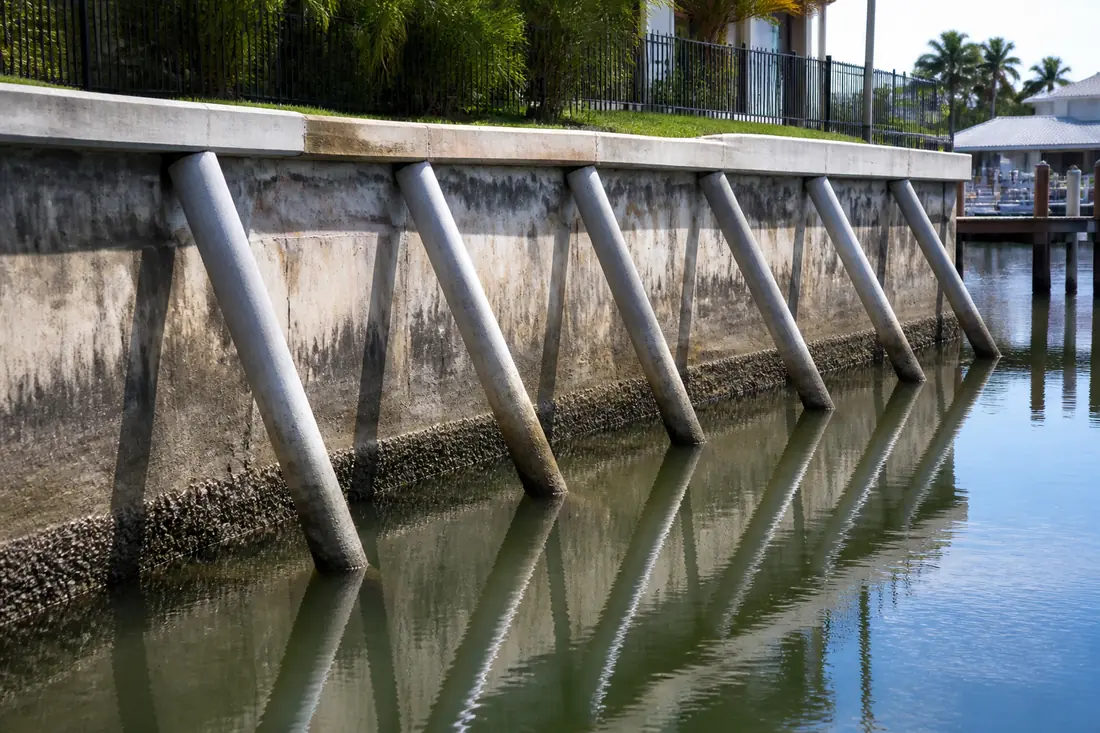
Those three things are the standard vocabulary of stabilizing a wall that has started to move rather than replacing it. A seawall cap ties the tops of the panels together and resists the outward rotation that opens the joints. Batter piles brace the wall against the load pushing it toward the water. King piles stiffen a run that is bowing between its existing supports.
The phrase carrying the weight is “used exclusively to stabilize and repair.” The exemption is for holding a wall up, not for extending the property or building something new under the description of a repair.
What “exempt” does not mean
This is the point where the money gets lost, so it is worth being blunt.
Exempt under 62-330.051 means exempt from that permit. It is not a statement that no permit is required, and it is not permission to start.
Charlotte County issues its own residential seawall permit through its building division, separate from anything the state does or does not require. Work in or over sovereign submerged lands can require separate authorization. Federal jurisdiction through the Army Corps of Engineers is its own track again. A wall inside the City of Punta Gorda sits under the City rather than the County. Each of these is a different office with different drawings, and an exemption from one says nothing about the others.
The practical rule: treat “no ERP required” as one box ticked out of several, and ask which of the remaining boxes apply to this specific address. A contractor who answers that question with a shrug is telling you something useful about how the job will go.
What Ian actually did here, and why it changes the diagnosis
There is a widespread assumption that seawall damage in southwest Florida is storm surge damage. On this stretch of coast, the record says something more specific and more useful.
Hurricane Ian made landfall on Cayo Costa at 130 kt — around 150 mph — on 28 September 2022, and its center came ashore again near Punta Gorda about ninety minutes later at an estimated 125 kt, roughly 144 mph. A mobile tower near the Punta Gorda airport measured peak sustained winds of 78 kt with a gust of 96 kt. The airport’s own station recorded sustained 76 kt with a gust of 117 kt — about 135 mph — before it stopped reporting.
The surge behaved differently. A USGS sensor at Pirate Harbor, just south of Punta Gorda, measured 4.47 ft above mean higher high water, less than thirty miles from the catastrophic water levels at Sanibel. The National Hurricane Center’s report records that the majority of sensors placed in Port Charlotte and Englewood, and northward through Tampa Bay, “remained dry and did not measure storm surge due to offshore winds.”
The water was pushed out, not in.
What arrived instead was rain and river. The highest storm total anywhere in the event was 26.95 inches at Grove City, just north of the landfall point, and the counties north of the track — Charlotte, Sarasota, Hardee, DeSoto, Polk and Manatee — saw the Peace, Myakka and Alafia Rivers and Horse Creek all crest at record levels.
That matters for diagnosis. A wall damaged by surge is damaged from the water side. A wall damaged by a saturated yard is loaded from behind, as groundwater raises the pressure on the back of the panels and finds the joints. The second is the mechanism that fits what the instruments recorded here, and it is slower to show itself. It also explains why walls in this county kept failing through 2023 and 2024 on properties whose owners had concluded they got through the storm.
If your wall started moving in the seasons after the storm rather than during it, that is consistent with what happened, not evidence that the storm was not involved.
What a professional looks at, in order
An inspection that is worth paying for follows the load rather than the appearance.
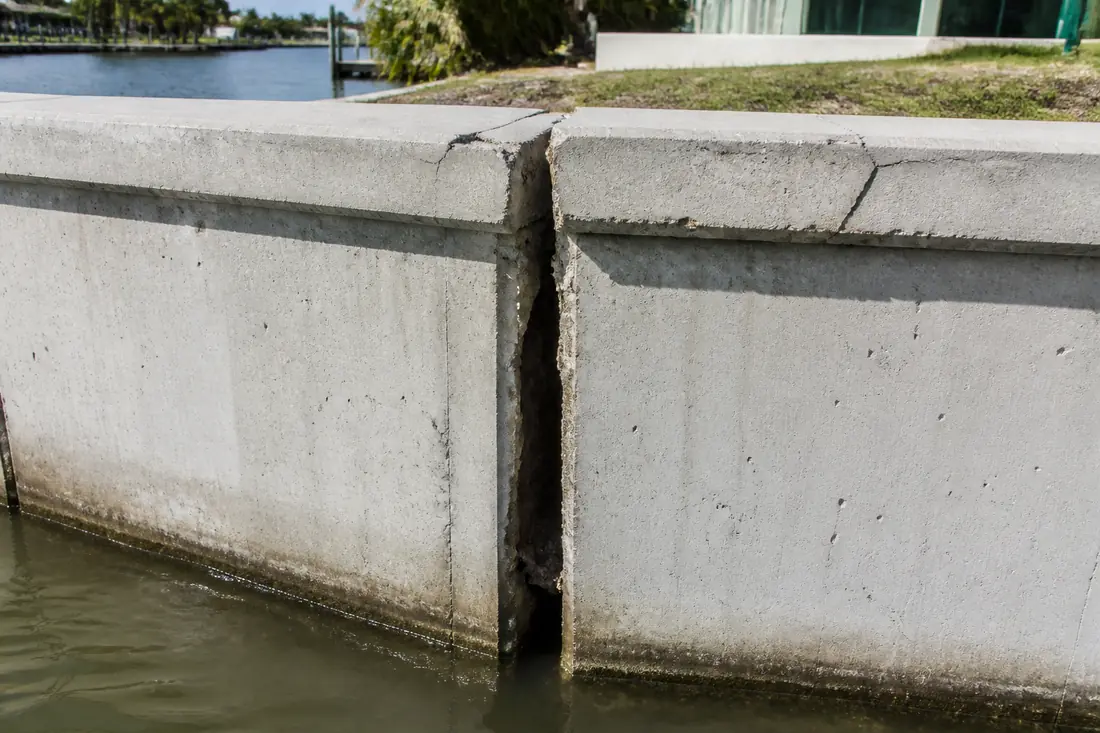
It starts behind the wall, not at it. Depressions in the lawn, a sunken paver, a sprinkler head standing proud of the grade around it — these say material has left the backfill, and material leaves through an opening. Then the cap, for cracks running across it rather than along it, which indicate the panels below are rotating apart. Then the joints, front and back, for daylight or soil. Then the weep holes, which should be draining; a wall whose weeps are blocked is a wall holding water pressure it was never designed to hold. Then the toe, where scour undermines panels from below. Then the tiebacks, which are invisible and are inferred from how the wall is moving.
The order matters because the visible crack is usually a symptom of something that started elsewhere.
Repair or replace
There is no universal answer, and anyone offering one without looking at the wall is selling their preferred scope of work.
The factors that push toward repair: the panels are sound and have moved as a unit; the cap is the thing that has failed; the loss is backfill through a small number of identifiable openings; the wall has not been previously rebuilt forward.
The factors that push toward replacement: panel cracking through the thickness rather than at joints; reinforcement visibly corroding; the wall bowing between piles rather than leaning uniformly; a toe that has been undermined along a long run; or a wall that has already used its 18 inches and is failing again.
There is also a timing factor that has nothing to do with the wall’s condition. If void filling is done while joints are still open, the injected material can find its way into the canal. Sequence is part of the decision, and a proposal that fills voids before closing the paths the soil left through is doing the steps in the wrong order.
What actually drives the cost
There is no meaningful price per foot without knowing several things, and a quote given over the phone is a quote given without them.
Access is usually the largest single variable. A property where equipment can reach the wall along a side yard is a different job from one where the only approach is by barge. Then the length of continuous run, since mobilization is a fixed cost spread across it. Then whether the old wall stays as backing or comes out. Then depth to competent bearing material. Then tiebacks, which are the part nobody can see and nobody can price accurately until the yard is open. Then the permitting path, which is the subject of this article and can add months rather than dollars.
Treat a bid substantially below the others on a canal, where everyone is working under the same conditions, as a scope question rather than a bargain. It may reflect a different scope — tiebacks omitted, or the old wall left in place where it should have come out. Compare the bids item by item before comparing their totals.
Common mistakes
Waiting for the wall to look bad. The visible stage is late. Soil leaving the yard is early, and it is the stage where the cheap options are still on the table.
Letting the one-year window close. Storm damage that is going to be restored under 62-330.051(12)(b) has a defined period. Deferring the work while other things get sorted can move the job into a different category.
Spending the 18 inches without knowing it. Building the new wall in front of the old one is often the right call. Do it knowing it is a card that can only be played once.
Treating an exemption as a green light. The state exemption is one of several approvals, and the others are local.
Filling voids without closing the openings. Material that leaves through a joint will keep leaving through it. Fill alone is not a repair.
Before you buy
If you are still deciding on the property, this is the cheapest moment you will ever have to find out.
Walk the yard behind the wall first, not the wall. Look for depressions, sunken pavers and settled slabs near the cap. Check whether the wall line is straight by sighting along the cap from one end — rotation is far easier to see along the wall than square-on. Ask the seller directly whether the wall has ever been replaced, and if so whether the current wall was built in front of the previous one, because that determines what the next owner’s options are. Ask whether any storm damage was claimed and when. Look at the neighbors on both sides; walls on a canal age together, and a run of new walls with one original in the middle tells you something about what is coming.
Then get the wall looked at before closing rather than after. A seawall is one of the few components of a waterfront property that can quietly carry a six-figure liability while presenting as a tidy concrete edge.
The sequence that saves money
Find out which category your work falls into before you design the job, not after. The order that costs the least is: establish what the wall is actually doing and why, establish which water body you are on and therefore which rules apply, establish whether a storm-damage window is open and how long it has left, then design the repair to fit inside the exemption if the wall’s condition allows it — and only then take bids.
Doing it the other way round produces the situation this article opened with: two credible contractors, two incompatible answers, and no way to tell which one has read the rule.
This guide explains the process in plain language and is not legal advice. The current regulations and the determinations of the agencies with jurisdiction over a specific property control what is actually required.
Sources
Opened and checked 6 September 2026, except where noted.
- Florida Administrative Code Rule 62-330.051, Exempt Activities — subsection (12) on seawall, riprap and shoreline stabilization; source of the (12)(a) exemption wording for artificially created waterways, the (12)(b) “damaged or destroyed within the last year by a discrete event” provision and the 18-inch waterward measurement, the (12)(c) exemption for seawalls or riprap in wetlands or other surface waters built between and adjoining existing structures at both ends, and the (12)(d) exemption for batter piles, king piles and seawall caps
- National Hurricane Center, Tropical Cyclone Report: Hurricane Ian (AL092022) — source of the Cayo Costa and Punta Gorda landfall intensities and times, the Punta Gorda wind measurements, the 4.47 ft Pirate Harbor water level, the finding that Port Charlotte and Englewood sensors remained dry because of offshore winds, the 26.95 in Grove City rainfall total, and the record river crests in Charlotte, Sarasota, Hardee, DeSoto, Polk and Manatee counties
- Charlotte County — Residential Seawall permit — not opened. Listed as a pointer to the office that issues the permit for an address in unincorporated Charlotte County. It refused automated requests when this was written, and no requirement, fee or specification in this article is drawn from it
Two sources could not be opened for this article. The Charlotte County permit pages and the City of Punta Gorda canals pages both refused automated requests, and the Florida Senate’s statute server did not respond. No County or City requirement, fee or specification is quoted here, and nothing is drawn from the text of Chapter 403 of the Florida Statutes. Confirm local requirements with the office that issues the permit for your address.