Seawall Repair in Port Charlotte, FL — What to Expect
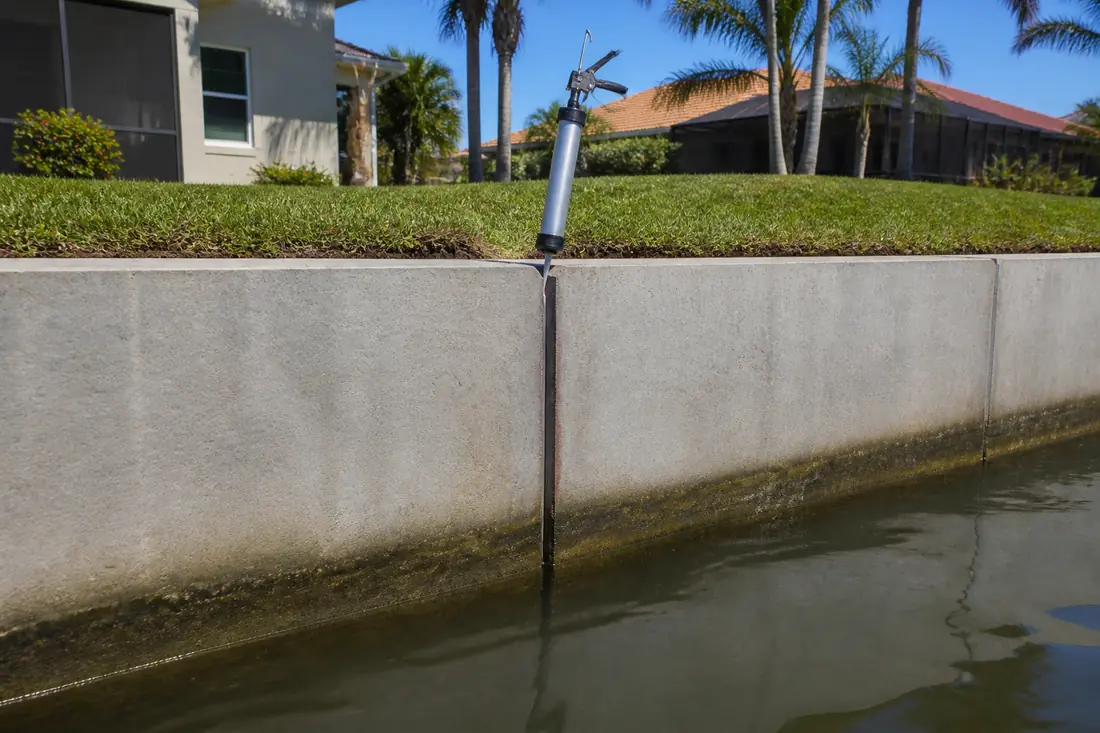
Most seawall failures announce themselves long before anything dramatic happens, and they announce themselves in the yard rather than on the wall. Soil escapes through an open joint or a cracked cap, and the ground behind settles. A depression in the lawn, a paver that has started to tilt, a pool deck with a hairline that was not there last year.
At that stage the structure is usually sound and the work is comparatively small: sealing the route the soil is taking, restoring what has been lost behind the wall, and correcting whatever caused the joint to open. The same wall two or three seasons later, after several storm cycles of continued loss, is frequently a replacement.
That gap between the two outcomes is why the timing of a repair matters more here than the technique. Nothing about a seawall gets cheaper by waiting.
What Is Included
- Joints and cap cracks sealed against continued soil loss
- Voids behind the wall filled rather than left to grow
- Cause of the opening established, not just the opening
- Straight answer when the wall is past repairing
What Matters When Choosing a Seawalls Contractor in Port Charlotte, FL
The yard tells you before the wall does
Soil leaves through a failed joint long before the structure moves. Depressions in the lawn and paving that has begun to tilt are the early, cheap signal — and they are the reason an inspection is worth more than a photograph.
Repair and replacement priced separately
A wall with joint separation and a wall that has rotated at the toe are different projects. Both get quoted where both genuinely apply, rather than defaulting to the larger one.
What is behind the wall gets assessed
Tiebacks and anchors sit buried in the yard and cannot be seen. They are diagnosed from how the wall behaves, which means the assessment covers more than the face you can photograph.
Seawall Repair FAQs
How do I know if my seawall needs repair or replacement?
It depends on whether the structure has moved. A wall that is losing soil through a joint but still stands plumb is usually a repair. A wall that has rotated at the top, bowed along its length, or dropped at one end has moved, and repairs to that tend to buy time rather than solve it.
There is a hole in my lawn near the seawall. Is that serious?
It is worth looking at promptly. Soil does not disappear on its own — a depression usually means material is leaving through the wall, and the void grows until something above it settles. Caught early it is a small job.